Meditation may be one of the most surprising and useful treatments for PTSD, here’s why.
Jun 17, 2016
By Megan Wells, PoliceOne Contributor
June is designated as national post-traumatic stress disorder (PTSD) awareness month, but it’s important to speak year-round about the symptoms of and treatments for PTSD to provide hope and awareness to those suffering with this life-altering mental illness.
Unfortunately, the issue of PTSD goes largely unaddressed in public safety roles because of the stigma first responders experience when speaking about mental health issues. The fear of being perceived as incompetent or not up to the job makes them hesitant to admit they need help. Rather, they prefer to deal with it on their own. The reality of losing a career or workplace camaraderie contributes to this issue.
PoliceOne has investigated the practice of meditation and its impact and healing properties on those living with PTSD. Meditation can be practiced by anyone, it doesn’t cost an arm and a leg to try, it can be practiced alone – and its healing properties, according to the professionals, are exceptional.
WHY DOES MEDITATION WORK?
Meditation is all about mindfulness and concentration. Erin Fletcher, regional Combat Stress Recovery Program director for the Wounded Warrior Project, says these skills are important for treating symptoms of post-traumatic stress “because it helps the individual increase contact with the present moment.”
Because PTSD is an anxiety disorder, episodes of distress occur when a person begins to worry about the future based on previous painful, intense or stressful memories. Meditation can help bring that person’s attention back to the current moment, which reduces or eliminates anxiety, she says.
THE SCIENCE BEHIND MEDITATION
The U.S. National Library of Medicine and the National Institutes of Health published a study in 2007 about the effects of Transcendental Meditation on Vietnam veterans who suffer from PTSD. The study, which took place over the course of three months, found that symptoms such as alcohol use, high-startle response, emotional numbness and anxiety decreased in those who used Transcendental Meditation to treat PTSD. The study concluded by stating that “Transcendental Meditation should be considered a possible ‘new and improved mode of treatment’ for PTSD.”
EXPERTS WEIGH IN
Dr. Lisa Long, a licensed psychologist, has worked extensively with first responders. She tells us it’s especially important to focus on PTSD in first responders – military, EMTs, firefighters and law enforcement personnel – because while some people experience one or two traumatic events within a lifetime, people in public safety are exposed to traumatic events often, sometimes daily.
“The frequency and lack of time to process and deal with exposure to trauma often leaves helping professionals in a situation where their symptoms of trauma become more complex as they are exacerbated by further trauma,” she said.
Long views teaching meditation to first responders as a preventative measure and a necessary for professional effectiveness.
“The more proficient you are with emotional regulation and peak performance decision-making, the better you will be at your job,” she said.
Dmitri Oster, a licensed social worker and counselor, works directly with first responders and says it’s important to address the specific challenges that they face.
“First responders have unique stressors,” he said, “and a therapist needs an understanding and appreciation for the specific work environment and cultural backdrop that many first responders and law enforcement personnel come from.”
Oster recalls a patient he worked with in the past who responded well to meditation.
“Meditation was helpful, as it allowed the client to take a step back from his stressors, mostly personal-life related, and begin to look at his situation from other perspectives to gain a larger view,” said Oster, adding that this client was able to develop more empathy for his significant other, which improved his relationship and functioning.
Annette T. Hill, clinical director at Warriors Heart, says the practice of meditation calms the individual and restores a sense of control.
“While meditation doesn’t fix the root causes of PTSD, it can help put distance between the symptoms and the person, giving them a sense of mastery and containment, making it possible to do that deeper trauma work,” she said.
WHAT ARE YOUR OPTIONS FOR PRACTICING MEDITATION?
The best part about meditation is that it can be done anywhere. You can practice at home, sitting in your car prior to starting a shift or anywhere else you feel comfortable. It can be done in a matter of minutes, too.
One of the most popular resources for Transcendental Meditation is the David Lynch Foundation. This group recommends 20 minutes of practice each day for optimal success. The foundation also recommends finding a teacher to help initially learn the practice, but once you’ve had guidance, you can start practicing alone.
Many yoga centers have guided meditation classes built into their schedule. Look for a yoga center near you for more information.
Mindfulness-based Mind Fitness Training (MMFT) was developed by Dr. Elizabeth Stanley with a strong emphasis on improving military resilience through mindfulness. It’s great for first responders, too, and many centers throughout North America offer this training. Here is a great article for finding a center nearest to you.
PTSD is a very real concern, and the more we speak about it and provide options for help, the more advanced techniques will become. Please, start the conversation and spread awareness, all year long.
I receive my Gatekey and I was so excited. I used it meditatng for 15 minutes. I had
this powerful love energy ran through my heart flow. I felt the energy rush and all i felt is love. I didn’t get a vision, but that was my first experience. The Love Energy! I love my Neo
Ok, I’ll try I just didn’t want to disturb the cube. I tried the Allore Pads- I don’t know what to expect?
However today when I was waiting to be seen. The personnel called someone other then me and I unexpectedly and immediately blurted out “I Was Next.” Oh boy I guess I’m getting courage and also today I had a doctor’s appointment in which I got lost and was an hour late.
They doubted about seeing me but it was unusual that I was NOT concern about it and sure thing- I didn’t wait long before they called me in. My doctor said “You were an hour late and we take back to back appointments- but you are lucky because someone cancelled.”
It’s the subtle incidents that I’m aware of -the incidents that I just mention and like looking down at my feet and finding a dollar bill.
I’m eternal grateful and I’m Aware. I thank the Neo- God in a Box.
Midtown Manhattan in the early summer isn’t the ideal place to meditate.
In addition to the symphony of city sounds—the whirring of an air conditioning unit, staccato bursts of taxi horns and sirens—the primal groans of several-beers-deep soccer fans following the Euro 2016 competition weave in and out of our brains as we try to find some inner peace.
The man leading several dozen New Yorkers on a meditation tour is Tom Voss, an Iraq War veteran who was 19 years old when he was deployed to Mosul in 2004. He is also one of the subjects of Almost Sunrise, a documentary that follows him and fellow veteran Anthony Anderson on a five-month walk from Milwaukee to Los Angeles. After their experiences in Iraq, both men suffered from post-traumatic stress disorder (PTSD), and they decided to walk after feeling they had exhausted all other treatment options. Anderson, for example, stopped taking prescribed antidepressants after they made him “as loopy as loopy can be.”
“It’s pretty clear that when someone says, ‘I’m going to drop what I’m doing and walk to California from Wisconsin,’ he’s dealing with something,” Emmet Cullen, who served alongside Voss in Iraq, says in the film.
Tom Voss, one of the Iraq veterans who walked 2,700 miles from Wisconsin to California to raise awareness of mental health challenges faced by many veterans, such as PTSD.ALMOST SUNRISE
Almost Sunrise explores the idea of moral injury, defined by the Veterans Affairs (VA) Department’s National Center for PTSD as “an act of serious transgression that leads to serious inner conflict because the experience is at odds with core ethical and moral beliefs.” That act could be “perpetrating, failing to prevent, bearing witness to, or learning about acts that transgress deeply held moral beliefs and expectations.” Moral injury, and the inner anguish it creates, differs from PTSD, which is triggered by a terrifying event.
As Voss and Anderson—heavily bearded and with rucksacks strapped to their backs—walk through Iowa, Nebraska, Colorado and New Mexico, they are forced to confront themselves and what they did (or didn’t do) while in Iraq. After five months and 2,700 miles on the road, they arrive in California. Anderson, it seemed, had healed, while Voss had not: He says the walk “wasn’t the end of the healing process by any means.”
The suicide rate among veterans in the U.S. is considered by many to be a national shame. A VA reportfrom 2012 found that 22 veterans commit suicide every day, and that their risk of suicide is greatest within three years after leaving the service. Meanwhile, about 300,000 service members suffer from PTSD or severe depression.
Before Voss embarked on the walk, he was experiencing nightmares and anxiety attacks associated with PTSD, and he would avoid large crowds and even July 4 celebrations—because of the fireworks. The VA prescribed him anti-depressants and Ambien, and Voss says he would often drink himself to sleep.
“It got to the point where I wanted to take my own life because I couldn’t stand myself, I couldn’t stand thinking about all these horrific things on a daily basis and all these moral dilemmas were slowly eating away at me,” he tells Newsweek. “I was completely losing the will to live.”
After the walk, Voss attended a Power Breath meditation workshop run by Project Welcome Home Troops in Aspen, Colorado. The course, which has been attended by 1,300 troops since 2006, teaches breathing techniques and meditation to help veterans decrease their levels of anxiety, insomnia, anger and depression, and to release deeply embedded trauma. Leslye Moore, national director of Project Welcome Home Troops, says the workshop aid people who have been “trained to shut down their emotions” in order to make themselves effective soldiers.
“It’s helping to shift their perception. The shame, the guilt, the remorse—whatever they’re feeling as a result of moral injury,” says Moore. “They’re able to reframe what they did or what they experienced and begin to experience forgiveness for themselves, for the military, even for God.” The workshops also allow veterans to develop a sense of community that may have been lost during their time away. “Nobody can relate to them and they can’t relate to other people. They’re missing that camaraderie,” says Moore.
Tom Voss and Anthony Anderson during their trek across America.ALMOST SUNRISE
The VA, says Moore, “is seeing that not everything works for everything individual.” Treatments involving drugs and therapy alone have differing efficacy rates and can be expensive: Between 2004 and 2009, the VA spent $1.4 billion on patients with PTSD, according to a 2012 government report. In the first year of VA treatment, the cost of treating patients with PTSD was $8,300 per person, nearly four times higher than someone without PTSD. For many veterans, including Voss and Andersen, alternative therapies are the only option.
“If we’re talking about the issue of moral injury, medication isn’t going to help that,” says Moore. “That’s an injury to the soul, and what’s going to help that is mind-body-soul, connection to community and helping process that experience and finding a way to reframe it so they can reenter their life.”
Research by Stanford University and the University of Wisconsin-Madison published in 2014 shows that breathing-based meditation—specifically Sudarshan Kriya yoga, which is used by Project Welcome Home Troops and was chosen for its effectiveness at reducing PTSD symptoms among tsunami survivors, according to the study—reduced PTSD symptoms in U.S. veterans who served in Iraq and Afghanistan. The VA says complementary and alternative medicine such as meditation, acupuncture and yoga is most commonly used to help veterans manage stress and improve “general wellness,” and can be used to treat PTSD, depression, back pain and other ailments. However, a challenge remains in “sorting through popular claims about the effectiveness of therapies that have not been rigorously tested in formal research,” the VA says.
Voss now teaches veterans breathing techniques and meditation. He also believes that service members could benefit from using breath work and meditation while on overseas deployment.
“When you come back from a mission you can do these breathing techniques within a half hour to help manage the stress and bring a lot of mental clarity,” he says. “When they get back from deployment, these breathing techniques are beneficial to help decompress from the overall experience.”
The meditation workshop in New York was held after the final screening of Almost Sunrise at the Human Rights Watch Film Festival. It’s the second time the filmmakers have included meditation as an “immersive experience” at a festival; last month, the film played at the Mountainfilm festival in Telluride, Colorado, and actors Aaron Paul and Sophia Bush were among those who attend the breathing session.
“One of my hopes of the film is that it will demystify meditation for the general public. This is not something that is strange, weird, Eastern,” says Michael Collins, the film’s director. “These are really effective, powerful techniques for everybody.”
Survivors of non-combat PTSD can also benefit from meditation and breathing techniques, says Moore. In addition, rape survivors and people recovering from traumatic injuries have attended a civilian version of the Power Breath workshop, and, when there are enough women, there is a course just for female veterans. For Voss, using breathing techniques to help heal his moral trauma was life-changing, resulting in “a tremendous shift, a complete shift.”
“I never thought I’d be this relaxed or happy,” says Voss. “I never thought this was possible.”
Almost Sunrise will show on the PBS documentary service POV in spring 2017. For veterans in crisis and those concerned about a veteran, help can be reached at the Veterans Crisis Line by dialing 1-800-273-8255 and pressing 1. The National Suicide Prevention Lifeline can be reached at 1-800-273-8255. Both services have online chat options.
Sujantra McKeeverFounder of Pilgrimage of the Heart Yoga and PilgrimageYogaOnline.com
Image credit: Pilgrimage of the Heart Yoga
Each week at our yoga studios in San Diego over 150 people come and enjoy our meditation, mindfulness and pranayama classes. Many of these students are brand new to this type of practice. Two of the questions I get asked most often are: “How do I know if I’m having a good meditation?” and “How do I know if this is the right technique for me?”
These two questions are intrinsically connected, and they are the same questions that I asked myself many years ago when looking for a spiritual teacher and an approach to meditation into which to invest my time and energy. The sheer number of teachers and approaches available today can be overwhelming, and as a beginner, sitting in meditation can be a puzzling experience. As your mind whirls and you feel the urge to fidget again and again, it is natural to wonder: is this working?
After all, choosing a meditation technique is a big decision. If you select an approach which is not a good fit, you are unlikely to continue with your spiritual practice. If you dabble in technique after technique without ever settling on a path, you may never see benefits. On the other hand, when you find an approach that really resonates, you will enjoy your practice more. Through consistent and ongoing practice, you will begin to see results: relaxation, focus, and peacefulness, among many others.
Once you have found a path, it is important to have tools with which to evaluate your experience. The challenge is that unless you’re hooked up to biofeedback equipment or inside an MRI machine, the experience of meditation is entirely subjective. You need a benchmark to evaluate both your own efforts and the techniques you are using.
My meditation teacher, Sri Chinmoy, was asked the same questions about meditation many years ago. His answer was simple yet profound, and forms the basis for the advice I offer to seekers at our studios and when I lecture around the world. I’ve taught meditation is 25 countries, and we are all dealing with the same basic challenges.
My teacher said: “We can easily know whether we are meditating well or not just by the way we feel about the world around us.” How we feel about the world is a direct reflection of how we feel about ourselves. Meditation, if done correctly, will make us more conscious of our deeper nature, which will make us feel good about ourselves. When you feel good, the world is a happy place. When you are down on yourself, everything will annoy and bother you.
He continued: “Right after our meditation, if we have a good feeling for the world, if we love the world or see the world in a loving way in spite of its imperfections, then we can know that our meditation was good.” Notice how my teacher says “in spite of its imperfections.” True meditation allows you to love unconditionally, and yet at the same time, see reality clearly. In seeing things clearly, we know some things need to be transformed both in the world and in ourselves. The meditation that is right for you will give you the ability to love both yourself and the world “in spite of its imperfections.”
Of course, the practice of meditation will also bring up unresolved issues that you need to deal with. As Bob Marley said, “You’re running away, but you can’t run away from yourself.” Through meditation you not only stand your ground, but you consciously turn and face the challenges. For me, meditation is synonymous with transformation. Genuine meditation gives you the energy, patience and wisdom to tackle those situations that need to be changed.
At the end of his answer, my teacher said: “Also, if we have a dynamic feeling right after meditation, if we feel that we came into the world to do something and become something good, this indicates that we have done a good meditation.” Look for that dynamic feeling in your practice. The meditation that is right for you will give you energy. It will not make you lethargic or lackadaisical. Meditation enhances and energizes your mind and body, and gives you the impetus to take action towards the transformation you desire.
Following these simple guidelines will help you find a meditation practice that is right for you. During and after meditation, stay tuned in to how you are feeling about the world around you and about yourself. In this way, you can ensure that whatever path you are following is taking you towards your best self.
My Neo Device always takes me into the deep Theta meditative state in less than a minute! Looking forward to more spiritual, occult breakthroughs with the Cube! Will update as I will practice intensively daily ! Thank you. Namaste!
How many times have you read or been told that stress is good for you? Yeah, that’s a lie.
It’s a convenient “truth” told to keep us all working to the bone every week with just enough energy left to cry “TGIF!!” before gulping down a beer or six, then go shopping the next day to make us feel better, collapse for a day of semi-rest + house and yard work on Sunday, then back to the grind the next day.
Work hard and spend money. Rinse and repeat…week in, week out.
Don’t get me wrong, actions and behaviors that lead to stress (and anxiety) can be good for you. Work ethic, productivity, solid goals and aspirations, resourcefulness, flexibility, competitiveness, and motivation (just to name a few) are vital for self-improvement and success.
The key here is balance.
In the United States we’re inundated with messages like:
if you want to achieve your dreams you have to work harder than everyone else
pull up your bootstraps and get to work
work hard, play hard
Yet, there’s nothing offered to counterbalance this go, go, go mentality every day aside from spending money on a product for a quick fix or maybe going to church once a week.
What we need is a shift toward the radical notion of self-care and rest. It’s time to prioritize relaxation and downtime, and incorporate habits into our lives that nurture our minds and bodies.
Then, when we have to deal with stressful or anxiety-inducing situations (a reality of life), we’ll have the mental and physical fortitude to easily withstand them. Sound good to you? Keep reading, friend!
Why I’m Discussing Stress & Anxiety Today
I’ve had several people approach me recently wondering how to address occasional stress and anxiety in a healthy way that doesn’t involve self-medicating with drugs or alcohol.
On top of this, I also dealt with an intense amount of anxiety in October, so it’s important to me to share what helped me cope while I felt overwhelmed.
I’m an extremely private person in real life (I mostly stick to recipes and DIY crafts here on the blog), so my decision to open up about my personal issues here where thousands of people can see it is totally out of character. ::deep breath::
However, I’m trying to break out of my shell because 1) it’s cathartic to discuss my issues, especially since I tend to internalize things and 2) my experience may help others, so I feel obligated to share.
What Stresses You Out And Makes You Want to Crawl Into a Hole?
Stress and anxiety affects all of us at some point. Everyone’s “trigger” or “breaking point” is different. It could be emotional issues, relationship or family squabbles, financial troubles, exhaustion, specific health problems, pressure to fit in, poor health (i.e. lack of nutrition and sleep), major life changes, physical trauma…the list goes on. In my case, it’s personal health issues. Most problems thrown at me will either roll off my back or manifest as regular stress in the form of tense muscles and a tendency to reach for comfort food (fried chicken, ice cream, or cheez-its) and an extra glass of beer or wine.
However, when I have irregular sensations on/in my body it triggers anxiety (something I differentiate from stress) in the form of significantly reduced appetite, rapid heartbeat, and shortness of breath. Nothing debilitating, but still inconvenient, especially if it occurs for too long.
My problem is that once something weird happens (something I haven’t experienced before) my mind goes into overdrive thinking of worse case scenarios and will not stop dwelling on it until I have an answer, usually from an expert (since it’s health related) or it begins to dissipate. Can you relate? Maybe you experience the same physical reactions, but the trigger is different.
I recently dealt with this for about 8-10 days after I shocked myself pulling out a clothes dryer plug. I initially shrugged it off, then began freaking out, let it get worse, then finally saw my chiropractor and regular doctsor, relaxed somewhat, still continued to have some anxiety, and then eventually began letting it go.
Long story short, the emotional aspects of our MIND have such a POWERFUL sway over our body. Our thoughts (intentional or not) can quickly cause physical reactions, especially when we’re stressed or anxious. That’s why it’s important in stressful situations to stay in control of our thoughts (the best we can). Easier said than done, right?
What options do you have when you’re feeling anxious or overly stressed once in a blue moon? What’s the best way to calm yourself down and let the stress go?
There is no one “right way” that works for everyone, which is why I’ve compiled a list of 30+ different relaxation and calming techniques here today. If you’re feeling stressed or anxiousright now as you’re reading this, I hope you can gain at least one practical method for calming yourself down and de-stressing from reading this post.
Several things on this list have worked well for me, and I intend to incorporate more of them into my life in the following months because (as I mentioned above) it’s good to practice self-care and prioritize rest on a regular basis.
(Note: Let me be clear that I’m discussing normal anxiety that happens to all of us occasionally, NOT crippling everyday anxiety that occurs day in and day out for six months to a year or longer. The latter falls in the realm of medical conditions, which I can’t address since I am not a licensed professional. I’m just one person who’s sharing her personal experiences and what’s worked for her in hopes of helping others. However, if you are dealing with ongoing issues I recommend seeking out a doctor, psychologist, therapist, naturopath, chiropractor, holistic nutritionist, and/or spiritual advisor for advice going forward. Do your research and keep your options open!)
30+ Ways to Relax and Keep Calm When You’re Feeling Stressed Or Anxious
1. Deep, Controlled Breathing
Mindful, steady breathing is the number one thing that helps me when I feel stressed, anxious, or panicky on occasion. Taking deep, slow breaths in through your nose and exhaling out your mouth ensures you’re getting enough oxygen and helps keep you physically grounded & focused on your body. This is tremendously helpful when your mind is racing and you need to re-center yourself. You can learn more about the benefits of deep breathing exercises here. I’ve also shared a Youtube video with a popular breathing exercise below if you’d like to try it right now.
Edit (4/10/16): You can also download free breathing & meditation apps on your phone. My favorite is an app called “Calm”. On the first screen (free version) it plays ambient rain music while showing a visual representation of a shrinking and growing circle to follow as your take deep breaths in and out.
2. Creative Visualization
Feeling super overwhelmed right now? Here’s a mental trick for calming yourself down. Visualize your stress or anxiety in your mind as a transitional object that shows up and then disappears. For example, picture your stress as a leaf that floats down in front of you and then blows away in the wind. Do this over and over again until you are calm.
3. Aromatherapy
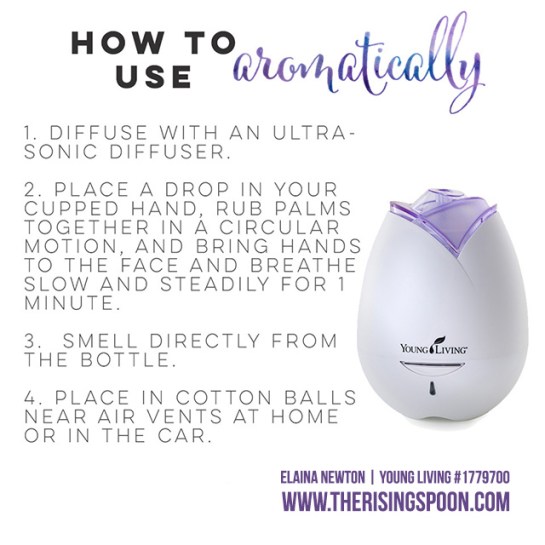
What feeling does the smell of freshly baked banana bread, chocolate chip cookies, orcornbread evoke for you? What about cut grass, a peeled orange, or a burning campfire? Scents have a powerful effect on us and the best and fastest way to reach the mood center of our brain is through our nose! When inhaled, essential oils (and other wonderful scents) travel up our nose to the limbic system and within seconds can transform our mood.
For me, the most powerful essential oils (in this case) are those with grounding properties that help calm my mind so I can refocus. When I take deep whiffs directly from the bottle they can quickly transform my mood. My favorites single essential oils for occasional stress and anxiety are true Frankincense (Boswellia carterii), Royal Hawaiian Sandalwood (Santalum paniculatum), Cedarwood (Cedrus atlantica), Vetiver (Vetiveria zizanoides), Idaho Balsam Fir (Abies balsamea), and Idaho Blue Spruce (Picea pungens). I also love the following Young Living essential oil blends: Stress Away, Peace & Calming, Valor, and White Angelica.
Who doesn’t like a hot bath? They are sooo relaxing. Well, you can make them even better by throwing in 1-4 cups of magnesium flakes (magnesium chloride) or Epsom salts(magnesium sulfate) + a cup of sea salt or baking soda, and 5-10 drops of essential oils (like lavender or frankincense) for aromatherapy. Don’t have any essential oils on hand? You can also throw dried herbs first steeped in hot water into your bath. Learn more about herbal bathing here and nab a recipe. No matter what you use for scent in your detox bath, the key ingredient here is the magnesium chloride or sulfate.
Why magnesium? “Every organ in the body, especially the heart, muscles, and kidneys, needs magnesium. This mineral also contributes to the makeup of teeth and bones. Magnesium activates enzymes, contributes to energy production, and helps regulate levels of calcium, copper, zinc, potassium, vitamin D, and other important nutrients in the body. You can get magnesium from many foods. However, most people in the U.S. probably do not get as much magnesium as they should from their diet.” Interestingly, certain scenarios like prolonged stress can lead to deficiencies of magnesium, and “inadequate magnesium appears to reduce serotonin levels”, which can lead to mood fluctuations (source).
This one is pretty self-explanatory (both help quiet the mind, reconnect you to yourself and relax your body) and pairs well with the deep breathing exercises from tip #1.
7. Emotional Release
For folks like me who tend to internalize their feelings, a good cry is an excellent way to relax your whole body and mind. An impromptu cry is easier said than done, so you may need to seek out a sad movie or book, or maybe even a token from the past, to get the tears flowing.
8. Physical Release
For folks who aren’t up for a good cry, physical release via exercise or any vigorous activity (like kickboxing, zumba, dancing, biking, or sex!) is excellent for a boost in endorphins. Personally, when I’m feeling stressed, I love to listen to the dance cardio station on Pandora and go for a short jog outside.
9. Talk with a Friend
Find your person–whoever that may be–and set up a time to see them or call them on the phone. Text, email, instant message & letters (yes, people still write these!) count, although these mediums won’t have near the same impact as an exchange where you see or hear the person. Video chat is a good compromise if you have a long distance relationship. Talking with someone you care about helps to distract you from your worries so you can calm down!
10. Practice Gratitude
When you focus on what you’re thankful for in your life, it puts things in perspective, improves your mood, and grounds you in reality. Try making a list of ten things you’re grateful for right now. Bet you it’s not hard! This works even better when you start your day intent on gratefulness and appreciating your surroundings.
Letting ourselves get lost in music can quickly improve our mood. Some folks prefer to listen to high energy music to boost their mood and let loose (their way of relaxing) while others prefer slow paced ambient music. I’m in the latter group! Whatever you enjoy, it’s really easy to find something quickly by doing a search on Youtube or using a music app like Pandora or Spotify. Put on your favorite jams then try out tips #1, 2, 3, 4, 5 & 15!
12. Refocus Your Energy
One way to quiet and relax our mind is by distracting ourselves with a task that requires our full concentration or a lot of energy and movement (something repetitive or trance-like may help even more). Try deep cleaning, organizing, knitting, solving a puzzle (crosswords, logic, sudoku), doing math problems, playing cards, or taking apart and putting together something.
13. Go Outdoors and Meander About
Spending time outside (no matter the weather) helps to ground us in the physical, get fresh air, and gives us lots of stimuli to keep our mind busy when we’re stressing about stuff. To ensure your time outdoors is well spent (not stressful), let yourself wander about without a destination or time limit. Give yourself a chance to slow down and explore your surroundings, even if that’s simply the birds chirping away nearby or the cracks in the sidewalk as you’re walking.
14. Acknowledge Your Feelings
Sometimes when we’re feeling anxious and our mind is running a million miles an hour, the best thing to help us calm down is by acknowledging that we’re experiencing anxiety. Give it a name and reassure yourself (multiple times over if need be), so you can identify it as a fleeting experience (happening as a result of our feelings) that will soon pass.
15. Massage Therapy
Since I tend to hold my stress in my neck, shoulders, and back, this is one of my favorite ways to relax (you’ll feel great for days afterward), although I don’t do it as often as I should. My favorite type of massage is deep tissue. It’s a bit intense (so not for everyone); however, it’s one of the best ways to work out the knots in my back! Just make sure you drink plenty of water before and after your massage so you can flush out all the built up toxins!
Don’t have the funds to visit a massage therapist on a semi-regular basis? Grab some simple tools like a foam roller, massage therapy balls, or tennis balls and use the ground or a wall to work on yourself. Check out this tennis ball massage series to learn how to do simple trigger point massages at home (warning: it can be pretty painful, in a good way, so take it slow).
16. Get Adjusted
If you’re too sedentary or active throughout the day, it’s possible that you’ve pulled your spine out of alignment at some point. If you’re experiencing discomfort or pain (especially due to stress), you may consider visiting a local (trustworthy) chiropractor to get adjusted.
17. Stretching and Yoga
Doing simple stretches once or twice a day is an easy and inexpensive way to help your body relax, give you more oxygen, and also boost your energy! As a blogger, I sit down way too much at a computer during the day, so I have to make a pointed effort to take breaks to stretch and get my body moving. Two of my current favorites are these quick desk stretches (you can do these sitting down) and these simple stretches and exercises to help undo the damage of sitting.
If you’re looking for more in-depth stretching and breath work for relaxation, get yourself an inexpensive Yoga for Beginners DVD to do at home or attend a local class! Want to save a few bucks? Look for free yoga videos on Youtube (like the one I linked to below) or used yoga DVDs at your local library or thrift store; however, if you want a yoga mat, I recommend youbuy one new. Used yoga mats = sweaty, dirty & gross.
18. Alone Time
For most introverts, it’s vital to have alone time in order to recharge our energy and mental health. Hanging around lots of people for long periods and engaging in small talk with strangers can be draining and lead to stress and anxiety over time. It’s important to make time to retreat and recharge, even if that’s only 10 minute mini-breaks in the bathroom listening to your favorite song or reading a book (if you’re a parent, grandparent, or sibling of a small child I’m sure you can relate).
19. Unplug
No phone. No computer. No portable gaming consoles. No TV. No frenetic, constantly updating information to keep up with or new emails to read. No pressure from the outside or endless, mindless distractions. Instead, pour positive energy into yourself and recharge by enjoying some quiet time unplugged. This pairs well with #4 and 13.
20. Do Something Creative
Working on a creative project or task helps you refocus mental energy toward something positive and productive. Some of my favorite ways to harness creative energy is crafting, writing, photographing, and cooking.
If you’re looking for ideas, check out my DIY crafts index, follow my Crafty Ideas Pinterest board, or browse through the Craftsy site for a variety of free or discounted classes that will teach you new skills on topics like photography, knitting, cooking, jewelry making, quilting, cake decorating, and more!
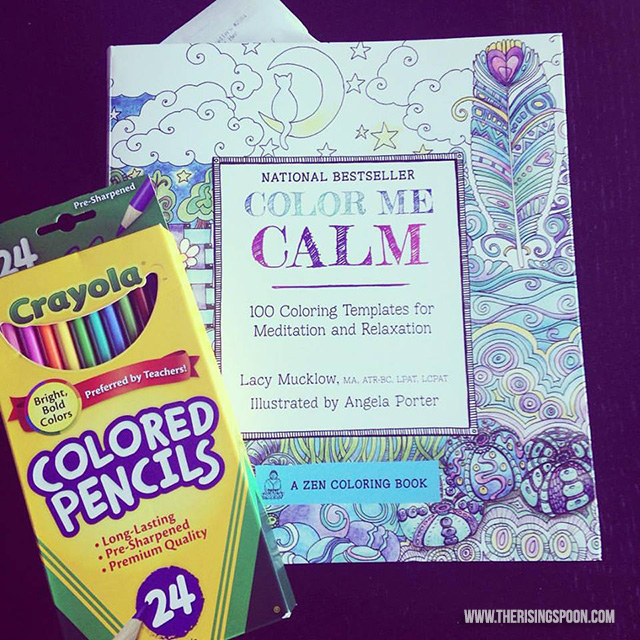
Art therapy of any kind is helpful for relaxing and refocusing the mind, but my favorite right now is adult coloring books. It is so fun and carefree to color away while listening to music and sipping on a cup of hot tea of a glass of wine. I just bought the Color Me Calm coloring book last week (pictured below) and LOVE IT.
Once I’m feeling calmer from doing methods #1, 2 or 3, reading is one of my favorite ways to de-stress. Reading actively engages your brain and allows “the self” to disappear for hours at a time as you’re transported through time and space via your imagination.
I usually buy new books locally to support brick & mortar bookstores (I don’t want them to disappear), but you can also find good deals online via Amazon. For used or free books, check out Half Price Books, thrift stores, your local library or university, or the daily free Kindle ebooks on Amazon (make sure to download the free kindle reading app if you’re not using your computer).
Living or working in an environment that’s cluttered with objects that don’t have a purpose or give you joy (taking principles from The Life-Changing Magic of Tidying Up) can create a lot of stress. All these things are taking up precious space and energy! I like to go through one type of item every 1-2 months (clothes and books are the main offenders in my home), reevaluate their purpose, and then donate. Edit: I completed the KonMari Method for “tidying” my home in early January and it totally changed my life & home for the better!
Need to recycle, donate, or throw away stuff, but not sure where to start? Check out this helpful Decluttering from A to Z series with lots of ideas for how to organize your home a little bit each day.
24. Make Sleep a Priority
One of the greatest factors in how well I can cope with stressful or anxiety-inducing situations is how much sleep I’ve had the night before. Sleep is vital for keeping your mind and body running properly. Want good sleep and enough of it? Make it a priority. Invest in a good mattress + pillows that won’t leave you tossing and turning all night.
Go to bed early (on purpose). Sleep in every chance you get, even if that means saying no to early morning social obligations. Take naps! They’re great for quieting your mind and resetting your body during the day when you’re feeling frazzled. I like to take 30 or 90-minute naps so I don’t wake up groggy.
25. Detox
Sometimes our bodies need a gentle detox (i.e. break) in order to get our digestive system back on track, especially if we’ve been dealing with stress or anxiety, both of which directly impact our digestion. If that’s the case, I recommend checking out my 15 Ways to Detox Naturally Without Starving Yourself or Going Broke post for easy ideas.
26. Engage in Small Acts of Kindness
Need a break from your thoughts and worries? Step away from your problems by focusing on others and how you can help them. It could be something as simple as complimenting a stranger or holding open a door for a mom with an armful of kids when you’re out and about, to putting together homeless care kits to give out during the holidays when you see someone in need.
27. Make a List and Plan
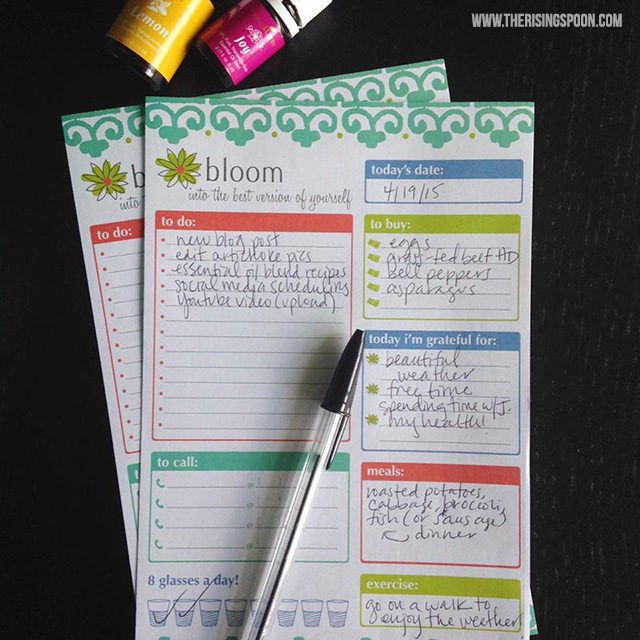
If you have a daunting task or goal that is causing you stress, tackle it on paper. Break the tasks down into small, actionable steps so you can feel accomplished by crossing off each thing. I have been known to frequently add “drink coffee” near the top of my daily to-do lists. Maybe it’s super cheesy, but crossing something off immediately tells my brain “hey, you achieved something! Now keep going!”
Long term to-do lists are also great, but (in my opinion) they never seem to work unless accompanied by a solid, actionable plan to help set them in motion. Otherwise they remain in the “I’ll do that in the future” category, i.e. never going to happen. But, hey…that’s whatyearly planners are for, right?
28. Do a Brain Dump
This one is super helpful if you’re a worry wart and/or have a lot of obligations on your plate. Grab a notebook and literally write down every single thing that comes to mind. Things that you need to do today, tomorrow, or the rest of the week. Long term goals you have, or events you need to plan for soon.
Write down everything that’s been floating around your brain. Passwords, emails, to-do lists, conversations, weekly appointments, random ideas–dump it all on paper. Doing this gives your brain a break from trying to remember every single little thing 24/7, which creates an immense amount of stress.
29. Watch or Read Something That Makes You Laugh
No one knows better than you what makes you laugh. Go find it and amuse yourself for an instant endorphins boost!
I’m totally a cat person, so this jerky cats video (shown below) always brightens my mood.
And the Sunny D meme below always makes me laugh. I can’t believe I never noticed this about their logo until it was pointed out. I drank this stuff up until I was 15 probably (gross)!
If you’re in a situation that’s causing you major stress or anxiety, step away, even if it’s just the next room over. Can’t separate yourself physically? For example, maybe you’re in the backseat of a car and the two people in the front are arguing (teenagers might relate). Distance yourself mentally by putting on some headphones and cranking up the music until it’s barely loud enough to cover the source of the noise or help you immense yourself.
31. Just Say No
Are you a people pleaser? You know, the type of person who always says YES to everything just so you can be seen as the “nice one” while also avoiding conflict? This is exhausting! Not only that but when your plate is already piled high with obligations and you keep blindly accepting more of them, it only leads to a ton more stress. In the long run, this can cause a weakened immune system and all sorts of other potential problems. When you’re already taxed, you need to learn to say “NO” politely and firmly so you can take care of yourself!
One of the best and fastest tricks when you’re feeling stressed or anxious (on occasion) is to focus on something happening in the present. Forget memories from the past that you always linger on and potential what ifs in the future you keep worrying about, and instead focus on something tangible here and now.
For example, place your hand on your chest and feel the rhythm of your heart beat. Or put a few fingers along your neck to do the same with your pulse. Feel the steady sensation and count the beats. Relax and know you are alive. Quick exercises like these where you focus on and acknowledge your fives senses help to bring you out of your thoughts and ground you in the physical.
33. EFT Tapping (Emotional Freedom Technique)
I was recently introduced to tapping by my sister after her accupuncturist recommended she try it for migraines. The basic principle behind this technique is that all negative emotion is caused by a disruption in the body’s energy systems. Our mind and body are intricately connected and any unbalance on either side affects the other.
Tapping can help restore the body’s energy systems and let you move past emotional issues by focusing (tapping) on specific merdian points on the body. While doing this you openly acknowledge your issues (whether physical or emotional) and then focus on the positive side by saying positive affirmations. You can read more about tapping here, here, and here.
My sister begged me for weeks to try this and I finally did. At first I felt a little silly, but within two minutes I was feeling really GOOD! It’s totally worth a try! What do you have to lose? Nothing!
Dancers swing and sway to the beat during a Spirit of Movement gathering at the Square Dance Center. Participants dance to a variety of music in the way they choose to express themselves.
It’s Sunday morning in Tucson. The lights are off, the air is cool, and people are dancing.
Some move like ballet dancers, others are more aerobic. One woman dances with a walker, another lies on the floor.
There’s no talking on the dance floor of this growing gathering called The Spirit of Movement, which regularly attracts upward of 60 people ranging in age from young adults to senior citizens.
Instead of speaking, this gathering is all about moving to a variety of music for two continuous hours. Some participants say it’s spiritual, others say it’s physical. Many say it’s both.
The creator of Spirit of Movement is Sandra Morse, a local communications expert who was inspired after she learned about a moving meditation called “5Rhythms” when she was at a workshop in California. She cites benefits as both emotional and physical health.
The physical aspect certainly can’t hurt. A study that came out in March in the Journal of Alzheimer’s Disease says regular physical activity, including dancing, can reduce the risk of Alzheimer’s as people age.
And the effects of meditation, prayer and spiritual practice on overall health are currently being studied at the University of Arizona’s Center for Integrative Medicine, led by renowned mind-body researcher Dr. Esther Sternberg.
Sternberg is using scientific rigor to show how stress makes people sick, and the way activities like prayer and meditation trigger reactions in the body that can make them well.
NO WRONG WAY
UA professor Tracey Osborne and her partner Sapana Doshi, also a UA professor, have been going to Spirit of Movement for the past year and a half. The weekly movement sessions began in November 2014.
“There are no limitations. You could be in a chair,” Osborne says. “You can be your authentic self.”
Both Osborne and Doshi are energetic on the dance floor, and have the glow associated with a rigorous workout.
“It’s a time when I reset for the work week — negotiate out the craziness,” Doshi says. “There is no wrong way to do it.”
She says after two hours, she always feels an emotional lightness, perhaps from the endorphins. Endorphins are chemicals that the body releases during exercise and are associated with positive feelings.
But it’s not just about working out. Doshi says there is a false dichotomy between mind and body, but that really they are very connected.
“This is about reconnecting to ourselves, our bodies, and doing it with other people. It is uplifting and inspiring,” she says.
Once people start, they find it hard to stop, says Melanie Cooley, who is beginning a movement teacher training program to earn her certification in 5Rhythms. Cooley says she believes she’ll be the first person in Arizona to be certified in the practice, and eventually expects to teach locally.
BODY LANGUAGE
The 5Rhythms was developed by the late American dancer and musician Gabrielle Roth as a practice intended not just for a physical workout but to ignite creativity, connection and community.
Learning about the 5Rhythms got Morse thinking about connection in the Tucson community, and about the way Americans have typically worshiped — passively sitting in pews. Getting people collectively moving on Sunday mornings seemed like a good alternative.
The Spirit of Movement is not a 5Rhythms class, nor is it an official practice of Roth’s method. But it’s based on Roth’s idea of expanding one’s world through dance, using music that corresponds with her 5Rhythms — flowing, staccato, chaos, lyrical and stillness.
Morse’s husband Michael Morse is a DJ for the local gathering, and plays tunes that range from Celtic to reggae to Brandi Carlile.
Sometimes people link arms and dance together, while others remain alone. They take cues from body language.
“We want freedom for people — freedom to move, freedom to express,” Sandra Morse says. “Everyone has rhythm. They don’t always know it, but they do.”
MIND AND BODY
The Sunday Spirit of Movement sessions start at 10:30 a.m. and begin slowly. People drop in and occasionally sit on the sidelines for a drink of water.
The music picks up speed, and by 11:30 a.m., many people are moving quickly, some of them vigorously jumping up and down. Shortly after noon the music slows, and by 12:30 p.m., most dancers are on the ground.
At the end of each session, the group forms a circle and joins hands. They briefly share announcements and welcome newcomers before leaving for the day. In spite of sharing almost no words, participants say they’ve become a community.
“The fundamental wound in our culture is the split between mind and body. This finds a way to integrate that,” Cooley says. “Our words and social conventions form a barrier. Here you get to know each other by your presence.”




 neomeditations.com