Thanks so much for your blog and writing about the Neo Cubes. I have two cubes, IDL 13 Skullem, and IDL 22. Your post inspired me to meditate 1 hour a day, I do have an hour a day. I did meditate with the Neo’s on an off not as great as you. Thank you for writing about your experiences which is inspiring me, yes the Neo’s do manifest quickly for the little meditation that I did. I did the 8 minute lottery video that James has and yes I did win the lottery which was $2.00 I have never had any success with manifesting so fast with the Neo cubes. I did win the lottery I definitely could win the big jackpot one day but there was more to meditating with the lottery cd than just winning it brings me to a very relaxing state and makes me feel wonderful I have so much PTSD and blockages that I didn’t continue consistantely but I am working on it. And I had to write to you, your experiences were just right for me to read at this moment and to forgo the anxiety outside of myself and go within, it so difficult with so much distractions I will read your blogs to get more inspiration and what could be possible.
Face it, if meditation were a pill, you’d want it. If it was a workout, you’d probably be doing it already. You’ve heard all about its much-lauded de-stressing capabilities; you’ve read that it boosts immunity, regulates sleep, and enhances memory, focus, and your gray matter; you know successful, smart people do it (Kobe Bryant, Novak Djokovic, Jerry Seinfeld, those snide geniuses at Google who call their in-house meditation class “Neural Self-Hacking”).
You know all of this, but, almost assuredly, you do not meditate. Why?
“There are three things,” says Dan Harris, the ABC News correspondent who chronicled his encounter with meditation in the highly skeptical (and highly hilarious) memoir 10% Happier. “The first is that guys think it’s bullshit — that you have to wear your wife’s yoga pants or chant. The second is that people assume it’s impossible: ‘My mind is too busy.’ ” Last, Harris explains, is that men assume meditation is all about being mellow, that it will rob them of their edge.
“We’ve been ill served by the art around meditation,” he says. “It shows people floating off into the cosmos with these beatific looks on their faces; that’s horseshit.” Harris believes meditation is more like a trip to the gym. It should feel like work, and if it doesn’t, then you’re probably cheating.
The workout metaphor is particularly apt. You should think of meditation as exercise, not magic or religion. Strip away the spiritual yada yada — the bells, the incense, your aunt in the oversize purple sweatshirt who’s always telling you that your chakras are blocked — and meditation is just training for your mind instead of your quads.
Which is why meditation has at least this much in common with CrossFit: It will be hard at first, and both the challenges and the rewards will increase over time. “It’s simple but not easy,” says Lodro Rinzler, a meditation teacher and co-founder of mndfl, a studio that takes a streamlined, boutique-fitness approach to meditation. “People think that if the mind wanders, they’re doing it wrong,” he says. “Everyone’s mind wanders. Be prepared — the mind is a wild beast.”
What makes meditation simple is that, according to Rinzler, you need to do only three steps: Sit with a relaxed, uplifted posture (“You don’t have to sit in perfect Lotus. You can sit in a chair”); bring your full attention to your breath; when your attention strays, as it surely will, come back to the breath.
The not-easy part: Trying to focus on your breath without getting caught up with what went wrong at work yesterday, or what you’re having for dinner later tonight, or why they didn’t give Gal Gadot a bigger part in Batman v Superman(or why — now that we’re talking about it — they don’t just give Gal Gadot a bigger part in every movie) is pretty much impossible.
“The mind is constantly going 100 miles an hour,” says Rinzler. “To think, ‘I’m meditating, it should go down to zero’ is unrealistic. It’s a gradual taming of the mind.” That’s taming — not emptying. “You will get lost a million times,” says Harris. “The whole game is to notice when you get distracted, and start over — and over and over and over. Every time you do, it’s a biceps curl for your brain.”
If you think you’re too ADD, antsy, or fidgety for meditation, think again. “Asking the mind to turn off is like asking the heart to stop beating — it’s not going to happen, and it wouldn’t be healthy if it did,” Rinzler says. In fact, he calls those moments when you catch yourself thinking “the golden opportunity.” Returning to the breath, again and again, trains the mind to be rooted in the present, not the past (work), the future (dinner), or fantasy (Gal Gadot). In this way, mindfulness is a little like being more awake: There’s less anxiety and more action.
You do not need years of practice to achieve this. One study by Harvard-affiliated researchers at Massachusetts General Hospital showed detectable neural changes after eight weeks in subjects who meditated an average of 27 minutes a day. There were increases in gray-matter density in the hippocampus, which helps with learning and memory, and decreases in the amygdala, the part of the brain associated with fear, stress, and anxiety. Meditate regularly and, research suggests, you can even increase brain volume in areas that usually get thinner with age.
At this point you may be thinking, “There is no way I have time for meditating 27 minutes a day.” No need. You can feel results from meditation nearly instantly.
We can get started right now, if you can spare 19 seconds. Breathe in while you count to four, hold that breath for a seven count, then exhale for an eight count. Congratulations, you’ve just meditated. You likely feel just a little calmer — that’s the relaxation response kicking in — and you’ve taken your first baby step into the most popular form of meditation, called “focused-attention,” where you direct your attention on an object, in this case your breath. Turn those 19 seconds into a few minutes by simply repeating the sequence. You’ll stoke your parasympathetic nervous system — the opposite of your fight-or-flight reflexes — which can improve relaxation, digestion, and recovery from workouts. Ta-da.
I’d tried meditation before. About a year and a half ago, I went to 15 sessions at the Path, a meditation group in New York. I was surprised that the hourlong 8 a.m. classes — or sits, as they’re called in the meditation world — weren’t more difficult. (My foot fell asleep, but I didn’t.) Still, I didn’t experience much in the way of change. And every time one of the organizers talked earnestly about taking our experience home and establishing a regular practice (“maybe just five minutes a day”), I felt the same way I did as a teenager after the dental hygienist finished a cleaning with a little wisdom on the importance of flossing. Of course, you’re right! Not going to happen!
Turns out, skipping regular meditation was almost certainly the reason I didn’t get much out of my 15 hours at the Path, other than some free herbal tea and a bit of calm that disappeared minutes after I got to my desk. “Consistency is the biggest thing,” says Andy Puddicombe, a 43-year-old former Buddhist monk and co-creator of the meditation app Headspace. His app — which has been downloaded over 6 million times and claims over 5 million active users — bills itself as a “gym membership for the mind,” with its program functioning as a personal trainer. “The analogy holds true with physical training — go [to the gym] two hours once a week and you’re probably not going to see loads of benefit,” he says. “Go every day for half an hour and you’re far more likely not only to develop the habit but to see sustainable results.”
One of the many things that makes Headspace easy to stick with is that it doesn’t even ask for a half-hour — just 10 minutes. To goad you on, the app uses some of the same adherence tools that activity monitors like Fitbit do (emails congratulating you for progress; tallies of “run streaks,” or consecutive days meditating; mindfulness push notifications to fire up motivation). And it’s content-driven, and that content makes the hard work of meditation almost absurdly inviting and clear. The first 10 sittings come with animation that looks like a Zen version of Pixar, illustrating precepts about recognizing your thoughts and then letting them go via cartoons about learning to watch the traffic instead of running out into it and chasing cars. Take a breath, have a thought, and then let it simply drive away.
The app also offers sessions for activities like commuting, cooking, and running, all designed to help you bring mindfulness into the part of your life that happens when you’re not sitting with your eyes closed. The walking sessions were a real eye-opener, and not complicated — I just focused on my steps the way I would my breath.
I was only a few weeks in when I noticed small changes that felt oddly impressive. I was leaving fewer dishes in the sink (because I’d begun to recognize the feeling of dread a growing pile of dirty dishes produced), watching less TV (because it suddenly seemed ridiculous to use it as a soundtrack to scroll through Twitter and Facebook), and I wasn’t arguing with my wife over small things so often. It felt like there was a fraction more space between my thoughts and my mouth, and I didn’t have to vocalize every thought in order to have it. I wasn’t the only one who noticed my calmer, amenable self. For my birthday, my wife told me we were going to Montreal, a reward, I thought, for my new behavior. (I’d suggested the trip numerous times but had never managed to get her onboard.)
The changes seemed to be happening surprisingly fast, and I wondered if they were a placebo effect. I asked Harris, and he told me he’d gone through something similar. “The initial benefits took a couple weeks,” he says. “The first data point for me is that, at parties, I would overhear my wife telling people that I was less of an asshole.” But if the dishes were getting done and I was getting rewarded with a trip I’d given up on, why argue with success?
What came next didn’t feel successful at all: All that awareness started piling up, and I felt overwhelmed by it. One of the upsides of being more mindful is the ability to explain my feelings without sarcasm. The downside is actually being more in touch with those feelings, including lots of annoyances I’d learned to tune out with TV, bourbon, and loud music (or all three at once). My insides started to feel like they were sweating — a weird internal struggle that no one else could see — which was an experience not nearly as fun as clean dishes.
According to Harris, this is a meditation tier-two problem. “You get over the hump, you do it every day, and then you start noticing moments like when your wife says something annoying — you now have the self-awareness to realize that your skin is crawling.” The old you would have served up a caustic remark without thinking. But now you have what Harris calls a superpower: mindfulness. “You have this urge to say something that’s going to ruin the next 48 hours of your marriage — but you’re aware of it, and so you have a choice.” Choose to acknowledge your feelings, then let them go, and you’re on your way to tier three. Here’s hoping he’s right. We leave for Montreal in 12 days.
You are invited to attend the 13th FESIG meeting (online with Zoom code as I’m away in Southern Spain) tomorrow, Wednesday, June 22nd at 5.30pm GMT. Please scroll down for Zoom code. In this meeting we will be honored with Mike Nashif, Yosan Pedro and probably Kike Flames (depending on his availability as he is in a leading Buddhist Retreat in France) too with contributions of shared ideas and wisdom.
Crystal was invited by Dr. Toledo B. Hughes to Spain, meeting up with Kike Flames and Asdrubal Hernandez, on the 11th June 2016, making some differing types of Q6s (Crystal made one for Kike and one for Toledo) and some varying health pen designs were created. There was an amazing fusion of energetic vibrational frequency that lead to a heightened state of awareness with Kike communicating intensely with the cubes, going online with his ‘White Lady’ plasma device. Bear in mind that Kike Flames is a special intuitive who was the 2nd person to communicate with the plasma intelligence right after Kosol in February 2016. Kike than had a name for his gift from Crystal, called ‘The Crystal One’. Dr. Hughes made her own health pen incorporating crystal gemstone at the end of the pen which looks beautiful! They are all connected now when in Valencia. As we are travelling now (was at the remote Buddhist Retreat in France), we’re not able to get online much, that’s why the postponement of the 13th FESIG Meeting to the 22nd.
The 12th FESIG Meeting was held on the 1st of June. It started with Infinity Project’s Mike Nashif answering questions while Crystal was busy tackling technical issues with the public computer of The Trust in South London. Then once the projector, microphone and everything got set up properly, the 12th FESIG Meeting resumed. Behold, while a master teacher is in session. They are gems! Learn, assimilate, put into practice, progress and benefit! Enjoy.
Please go to our FESIG site http://www.truevisionofpeace.com/fesig.html to get updates.
To reiterate, FESIG, as an open minded Futurist Freedom Seekers’ Group, welcomes creativity that pushes science and spirituality to the furthest frontiers, in the pursuit of knowledge, seeking breakthroughs to succeed in our objectives of making this world a better place to live in. Therefore we urge you to be on the lookout for new breakthroughs and developments, make contact and invite the people behind the tech to join us – as we have a platform for them present, share ideas and teach their others if they want to.
Please remember that our FESIG Meetings are held on the 1st and 3rd Wednesdays of the month. If for some reason I can’t email you or you can’t access your email, please go to the website page to get the Zoom ID to join the meeting if you can’t attend physically, attend online.
Topic: 13th FESIG Meeting
Time: Jun 22, 2016 5:30 PM (GMT+1:00)
Join from PC, Mac, Linux, iOS or Android: https://zoom.us/j/4345910351
Or iPhone one-tap (US Toll): 14086380968,4345910351# or 16465588656,4345910351#
Or Telephone:
Dial: +1 408 638 0968 (US Toll) or +1 646 558 8656 (US Toll)
Meeting ID: 434 591 0351
International numbers available: https://zoom.us/zoomconference?m=kBS0ddtt1ImOFOghEaeljqsrEkfmjszXPlease spread the word (share our link http://www.truevisionofpeace.com/fesig.html in your fb, twitter, & other social media) so we’ll be able to sustain better with more participation and volunteers – perhaps we’ll get some help and donation to enable a more efficient system and grow faster in our pursuits for Science and spirituality!
Thank you.
Blessings,
Crystal
FESIG
The Trust,
The Community Centre
21 Aytoun Place
London, SW9 0TE, U.K.
Neuroscientists and psychologists keep discovering more health benefits from mindfulness meditation. And luckily, it’s a simple practice, that virtually anyone can do. But how do you get started, and how do you get the most rewards from the practice? Here’s our quick and easy guide to meditating.
Mindfulness meditation, or focused attention, turns out to bring a surprising number of health benefits, including stress reduction, better attention and memory, and even increased creativity and feelings of compassion. It can alleviate disturbed sleep, restructure our brains for the better, and help you lose weight. It’s also incredibly relaxing and reinvigorating.
There are many different ways to meditate, but for the purposes of this article, and because it’s the most studied form, we’re only going to consider mindfulness meditation. That’s not to suggest other forms of meditation aren’t likewise valid or beneficial.
An Ancient Practice, A Modern Need
Mindfulness meditation can trace its roots all the way back to the Theravada tradition of Buddhism. And in fact, it’s often considered the first real attempt to study mental processes in a systematic way.
Developed over 2500 years ago in what is now India, its basic purpose was to help practitioners perceive things as “they really are” and for them to gain enhanced control over their (often scattered) thought processes. Today, mindfulness is practiced both within and outside of the Buddhist context. You don’t need to be spiritual or a Buddhist to reap the many benefits of focused attention.
The University of Massachusett’s Colleen Camenisch discusses mindfulness at TEDxReno
“Mindfulness meditation is unique in that it is not directed toward getting us to be different from how we already are,” says Dr. Karen Kissel Wegela of Naropa University. “Instead, it helps us become aware of what is already true moment by moment. We could say that it teaches us how to be unconditionally present; that is, it helps us be present with whatever is happening, no matter what it is.”
It’s never been more difficult to stay focused on the moment, or on a fixed concept or task. Modern technologies in particular have created an intensely distracting environment, and our attention spans have suffered accordingly. We dart from activity to activity, in an often futile effort to multitask. Mindfulness offers practitioners the opportunity to to stop this cycle and focus on one concrete thought.
Getting Started
You can meditate at virtually any point during the day, and you can do it as many times as you want, and for however long you want (but just like anything else, don’t overdo it). Some people prefer mornings, others like to do it just before bed. Some folks meditate for five minutes, others for 20 minutes, and some for an hour or more. Personally, meditating for 20 to 30 minutes works best for me. And in fact, during the course of a 2011 study conducted by the University of Massachusetts Center for Mindfulness, beginners spent an average of 27 minutes each day practicing mindfulness meditation. That’s a good benchmark time to be aware of. Eventually, with much practice, and as you get more comfortable with the sitting position, you should be able to extend that to an hour or more (if you want).
Feel free to use a clock to time your sessions. I set a timer to avoid peeking, and to minimise agitation. You can challenge yourself to go on for longer, and you shouldn’t give up too easily — but remember, this isn’t a duty or obligation.
When setting up to meditate, you’ll want to make sure that you’re doing it in an appropriate environment. Ideally, you’ll want to do it in the same spot each time. Make sure all mobile devices have been switched off, along with anything else that has the potential to distract you. The quieter the better. Also, minimise the lighting in the room. Sometimes, a single candle is all you need.
How to sit during meditation
In terms of positioning yourself, there are many possibilities. Just be sure to pick a position that provides a stable feeling in the body so that you can center your concentration on the object of meditation.
Lotus position (sitting cross-legged with your feet on top) is the most traditional posture — but it’s not for everybody. Personally, I like to sit cross legged, i.e. the Burmese position, while sitting on a pillow, cushion, or folded blanket. Some folks like to sit directly on the floor, and that’s fine, too. Other options include the Seiza posture, i.e. kneeling, sitting on a chair (no dangling feet), or lying down on the floor (just make sure you don’t fall asleep!).
Here are some general rules for what you should do with your body, as described by the Vipassana Fellowship:
The most essential thing is to sit with your back straight. The spine should be erect with the spinal vertebrae held like a stack of coins, one on top of the other. Your head should be held in line with the rest of the spine. All of this is done in a relaxed manner. No Stiffness. You are not a wooden soldier, and there is no drill sergeant. There should be no muscular tension involved in keeping the back straight. Sit light and easy. The spine should be like a firm young tree growing out of soft ground. The rest of the body just hangs from it in a loose, relaxed manner. This is going to require a bit of experimentation on your part.
We generally sit in tight, guarded postures when we are walking or talking and in sprawling postures when we are relaxing. Neither of those will do. But they are cultural habits and they can be re-learned. Your objective is to achieve a posture in which you can sit for the entire session without moving at all. In the beginning, you will probably feel a bit odd to sit with the straight back. But you will get used to it. It takes practice, and an erect posture is very important. This is what is known in physiology as a position of arousal, and with it goes mental alertness.
If you slouch, you are inviting drowsiness. What you sit on is equally important. You are going to need a chair or a cushion, depending on the posture you choose, and the firmness of the seat must be chosen with some care. Too soft a seat can put you right to sleep. Too hard can promote pain.
Another option is walking meditation, or Kinhin of the Zen Buddhist tradition. This technique is a bit more challenging given the potential for distractions, but it can be done with enough focus and practice.
It’s also a good idea to stretch prior to starting your meditation. I suffer from lower back pain (more on dealing with pain later), so I prepare by doing a number of back stretching exercises, including cat’s pose,cow pose, upward facing dog, and various spinal twists.
As for clothing, wear something loose and soft.
Once I’m ready to go I start by taking 10 very deep and long breaths. Once that’s done I enter into meditation mode, focusing on inhalation and exhalation while calming myself down with each passing exhalation.
Fixing Yourself to the Present Moment
A common misconception about mindfulness meditation is that practitioners put themselves into a profound state of relaxation while clearing their mind of all thoughts. Not exactly. Rather, practitioners are hyper-aware of a single, consistent thought — and it takes a bit of effort to stay focused. Practitioners are like ducks on an pond. At the surface, they look calm and serene, but at a deeper level they’re busily working away.
The point of mindfulness is to focus on what is happening in the present moment to the greatest and longest extent possible. Typically, this means concentrating on the breath. There are a number of reasons for this, including the fact that it’s readily available to anyone at any time, it’s a passive activity, and it has symbolic power as a life-giving, cyclical force.
Each inhalation and exhalation is tracked with focused attention. When meditating, it’s important to identify the in-breath as the in-breath, and the out-breath as out-breath. Should a stray thought arise — which they often do — the practitioner should do their best to (1) recognise that their mind has wandered from the breath and (2) quickly and calmly return to the breath.
Very simple, very easy. In order to recognise your in-breath as in-breath, you have to bring your mind home to yourself. What is recognising your in-breath is your mind, and the object of your mind — the object of your mindfulness — is the in-breath. Mindfulness is always mindful of something. When you drink your tea mindfully, it’s called mindfulness of drinking. When you walk mindfully, it’s called mindfulness of walking. And when you breathe mindfully, that is mindfulness of breathing.
So the object of your mindfulness is your breath, and you just focus your attention on it. Breathing in, this is my in-breath. Breathing out, this is my out-breath. When you do that, the mental discourse will stop. You don’t think anymore. You don’t have to make an effort to stop your thinking; you bring your attention to your in-breath and the mental discourse just stops. That is the miracle of the practice. You don’t think of the past anymore. You don’t think of the future. You don’t think of your projects, because you are focusing your attention, your mindfulness, on your breath.
How slowly you actually breathe is up to the individual. An in-breath can take anywhere from three to five seconds. Just make sure that it’s at a comfortable and natural rate. And be sure to perceive the in-breath/out-breath cycle as a continuous loop with no discernible start or end points.
It’s important to note that the breath does not have to be the only focused point of attention. It can be virtually anything — a stationary object in the room, your heartbeat, a metronome, or the practice of counting breaths (see video above). You can also focus on a word or a concept, like a mantra. The most common mantra is “Aum” or “Om,” the sacred sound of Hinduism — but you can choose any mantra you want.
Taming the Monkey Mind
Inevitably, the first several minutes are among the most difficult and distressing. It’s during this initial “warm up” phase that your mind is still abuzz with activity. It’s what practitioners call your “monkey mind,” or “racing mind.”
During meditation, and often without even realising it, we find that we’ve drifted away from the breath. We start to think about what we should make for dinner. Or we start obsessing about a stressful incident at work. We’re suddenly hit with the feeling that we left the light on in the bathroom. The face of a person who we haven’t thought about in years suddenly pops up in our head. It’s actually quite remarkable how random and inexplicable these ideations often are.
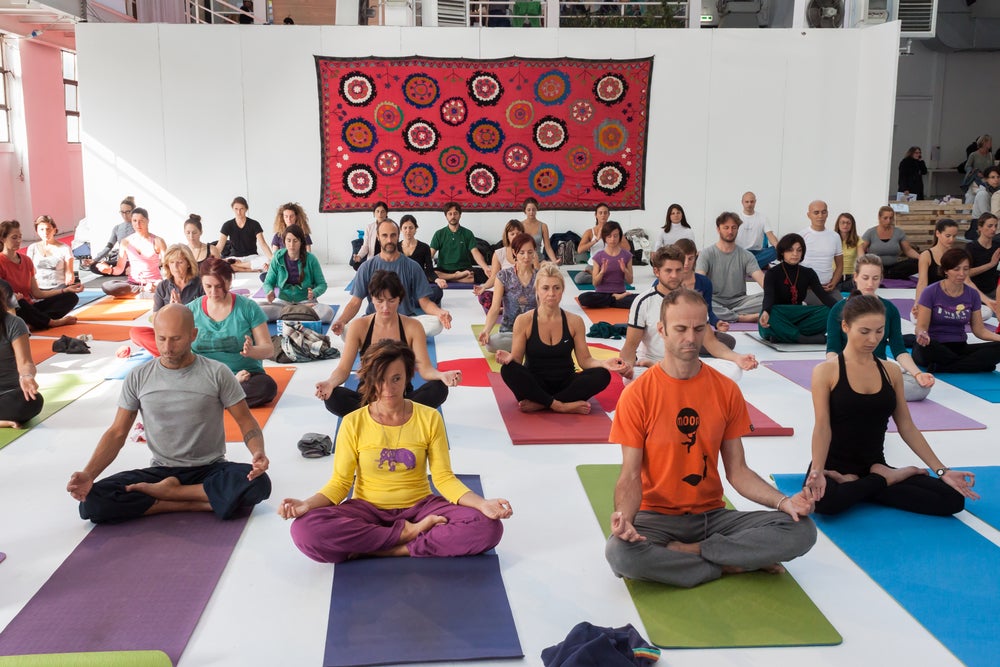
Meditation is often practiced in conjunction with yoga. (Image: Stefano Tinti/Shutterstock)
There are several important things to remember when this happens.
First, don’t get upset. It’s completely normal. Bhante Gunaratana, an expert in Vipassana meditation, puts it this way:
What a bother. But this is what it is all about. These distractions are actually the whole point. The key is to learn to deal with these things. Learning to notice them without being trapped in them. That’s what we are here for. The mental wandering is unpleasant, to be sure. But it is the normal mode of operation of your mind. Don’t think of it as the enemy. It is just the simple reality. And if you want to change something, the first thing you have to do is see it the way it is.
When you first sit down to concentrate on the breath, you will be struck by how incredibly busy the mind actually is. It jumps and jibbers. It veers and bucks. It chases itself around in constant circles. It chatters. It thinks. It fantasizes and daydreams. Don’t be upset about that. it’s natural. When your mind wanders from the subject of meditation, just observe the distraction mindfully.
In fact, that’s you make progress in meditation — by lengthening the time we go from thoughtful awareness to experiencing wandering thoughts. Over the course of a single session, and most certainly over the course of multiple sessions, your ability to stay focused should improve. Very few people can actually sit for protracted periods of time and focus exclusively on a breath. I find that I’m at my most focused between minutes 10 and 15 during a 20 minute session. My goal is to extend that even further.
It’s also important to point out that your “monkey mind” doesn’t mean there’s anything wrong with you. Many people, upon experiencing these racing thoughts for the first time, are suddenly concerned that they’re losing their minds, or that the meditation has caused them to experience these scattered thoughts. Rather, it’s the power of meditation — and engaging in thoughtful and deliberate periods of focused concentration — that we notice our monkey minds. This is how we live pretty much all of the time. But it’s only during meditation that we recognise it and work to reign in the spasmodic nature of our minds.
Lastly — and this bears repeating — once you’ve discovered that you’ve drifted away from the breath, just stay calm, set the idea aside, and return to the breath. Inhalation, exhalation.
Dealing with Problems
Needless to say, not all meditation sessions go as planned. As mentioned, I struggle with back pain, which can be incredibly distracting. Sometimes, I get an itch.
When this happens, I shift my attention away from my breath, and onto the pain. In a technique borrowed from yoga, I exhale in and out of the pain. I heighten my awareness and acceptance of the pain, avoiding negative emotional feelings in response to it. Regrettably, this doesn’t always work, so I sometimes take a break and stretch, or change positions (like sit in a chair).
Buddhist monk Ajahn Brahm offers his advice on dealing with distractions, like pain.
Noise can also disrupt a session. Perhaps someone in the house turned on the TV, or the neighbours are busy chatting away. Again, it’s important not to give up when this happens or get frustrated. Consider it an added challenge to the session. Like physical pain, focus your attention on the source of the distraction and learn to cope with it rather than trying to avoid it.
You can find more on how to deal with problems and distractions — such as incessant mind wandering, agitation, and doubt — here and here.
Final Notes
Needless to say, this meditation explainer was short and straight to the point; there’s a lot more detail and nuance about mindfulness that I had to leave out. To get started, you may want to consider joining a meditation class. But if you’re set to go it alone, be sure to read this excellent and comprehensive 18-part guide written by Henepola Gunaratana.
Lastly, in the midst of today’s hustle-and-bustle, it’s important to remember this Zen proverb: “You should sit in meditation for twenty minutes every day — unless you’re too busy. Then you should sit for an hour.”
One form of meditation which has evolved more recently is that of “guided meditations”. In these meditations, either live or recorded, one is voice-guided step-by-step through a meditative experience.
There are many different approaches to guided meditation, and they have different purposes. Some have a very specific purpose, such as healing or self-improvement with goals such as creating prosperity, improving relationships, developing forgiveness or any number of other goals. Other guided meditations are more general, aimed at quieting the mind and producing calmness and relaxation. Some are designed to evoke “higher states of consciousness” or to enliven various aspects of the human energy field (for example, various “chakra” meditations).
Many guided meditations use imagery, either describing very specific images which produce certain experiences, or inviting the listener to allow their own images to appear. Others may be body-focused, for example an instruction in progressive relaxation, or there may be instructions with regard to the use of the breath.
Guided meditations invariably reflect the background and orientation of the “guide”. If a meditation guide has a background with some particular meditation tradition, that will invariably influence the style of guided meditation. They might reflect a particular religious or spiritual tradition, such as Buddhism or Christianity, since meditation in one form or another is a practice in most religions.
Meditation can be an invaluable tool for creating health and well-being, as well as personal and spiritual growth. Some people will learn practices they can use on their own, but for others, meditating with a guide may be most effective. Even those with a regular meditation practice can benefit from various forms of guided meditation.
Being guided allows for an effortlessness that may be difficult to achieve on one’s own.
I have two cubes, IDL 13 Skullem, and IDL 22. I meditate 1 hour a day, with the Neo’s on an off . The Neo’s do manifest quickly for the little meditation that I did. I did the 8 minute lottery video that James has and yes I did win the lottery which was $2.00.
I have never had any success with manifesting so fast with the Neo cubes. I did win the lottery I definitely could win the big jackpot one day but there was more to meditating with the lottery cd than just winning it brings me to a very relaxing state and makes me feel wonderful.
I have so much PTSD and blockages that I didn’t continue consistantely but I am working on it. And I had to write to you, your experiences were just right for me to read at this moment and to forgo the anxiety outside of myself and go within, it so difficult with so much distractions.




 neomeditations.com