Archive

Author Archives: James Rink

Ram Dass interviewed on the BBC in 1981. Ram Dass tells his story. Ram Dass is spiritual not religious. The entire universe is lawful in its unfolding. It’s not by chance that each event occurs. It is a set of lawful interactions. It is best to listen for your part in the play, not the chooser. We have taken a human birth to have a series of experiences which are vehicles for our awakening out of the illusion that we are exclusively separate. The journey of awakening goes from seeing yourself as separate to seeing that this “you” is only relatively real. You are separate on one plane, but going up one level, you see that we are not separate.

When you read this you will filter it through what you know, what you think you know, because there has been a long history of meditation tradition that is taken to be true, because of thousands of years of tradition. I take exception: what people say about meditation is 99.9% bulldust, and those who profess to teach the ‘tried and tested’ techniques are book learned themselves and pretending to others.

Meditation instructors will be all up in arms about that, but not surprisingly since I adamantly disrupt thousands of years stale old hand me downs where each generation is scared pantsless of straying from security of tradition, but I claim that it’s all dead dusty old stuff. All dried up like the ink it is written in.

Meditation is momentarily alert, alive and aware. It isn’t rigid like a perfect posture, repetitive like a hypnotic mantra or controlled like a slavishly obedient, yet inherently resentful, mind.

Meditation is captured by the word ‘sati’ which means awareness or to observe. We are already aware and we are already watching. That’s what it is to be alive. We can’t teach it because we already know it. Teachers will tell you what to watch, what to chant, what to visualise – but the meditation is self awareness, and the knowledge of self.

You are not a static thing that is captured and retained as knowledge that can be taught – you are living, being, thinking and changing from moment to moment. One does not observe anything stationary or repetitive. One is the witness to life, which is vital and dynamic.

The meditation does away with the repetition of habits and reactions ingrained in us by upbringing. It dispenses with the comparisons so popular throughout school, career, society and the spiritual status quo. It relinquishes all standards of religious rote and dictatorial society. It’s disruptive and disobedient not because it’s rebellious, but because it’s truthful. Some few will appreciate that.

If person really wants meditation, they will know the truth about themselves and will not to be able live according to any traditional norms or institutional paradigms anymore; rather, they will live in truth to themselves. That is the essence of transformation.

When I first sat down with my IDL80 it felt this would be a long term relationship. When you first use one it almost knocks you and sometimes it’s so strong it makes you tired. The first time I used it was for 15 minutes and then the next time was an hour. I kept thinking to myself, are you there? Are you in there?

When I didn’t get the 31 times the power blast like it says on the website, I was worried I was talking to the wall. Then I went away for a week and came back and realized you have to use these devices for the right reasons. So now I don’t ask in an egotistical manner. I place myself in a spot where I can give more. The only truth of the universe is love. I know karma is a bitch. So I don’t ask for anything negative only wondrous, prosperous stuff.

I also realized I needed to spend more time to develop a relationship. These devices tune into consciousness and just like life is smarter than us; the best you can think of is where consciousness starts. Consciousness is infinite, it has all the answers, knowledge, and experiences. So now I let the device tell me the best way to deal with me. I think the IDL80 is much much more powerful but it hasn’t shown me yet as I think it’s because I don’t know what I want or supposed to do in my life. I feel we have to put ourselves on the same page by both agreeing to what we need. Because when you bring two or more minds together you get a master mind, and then you can tap into the infinite.

I spent much of my life trying to change the world from the outside and in the process knocking myself out with blood sweat equity. I look at my work from the past 18 years. I was the top of everything, school, my job, etc. but things didn’t work for me. I know the law of attraction.

For a limited time the IDL-80 is 25% off. Upgrade your meditation experience and feel the supercharged power of this meditation cube.

http://www.neologicaltech.com/product_p/idl80gk.htm

January 5, 2016

Millions across the world vouch for ‘Yoga’ as a way of life but not many understand how the Asanas, Pranayam and meditation actually affect our body’s ‘Chakras’.

Chakras? That’s right.They are the ‘Energy Wheels’ located in specific parts of our body. These constantly spinning Chakras are associated to particular organs which, when worked upon, provide the organs the required energy to perform their function.

Did you know that there are total of  114 chakras in our body?! However, there are 7 main ones in our body that are in the form of a prism. Read on to study the importance of these Chakras in your life and what you should do with them:

View photos

1. Root or Muladhara Chakra

Located at the base of the spine, this Chakra is connected to the adrenal gland. You can visualize it as the roots of a tree which, when awakened, will provide inner strength and stability to the tree (in our case life). Tadasana, Paschimottanasana, Setubandasana and Uttanasana energize the root chakra.

2. Sacral or Svadishtana Chakra

Located just below the navel, this chakra associates itself to the kidneys, bladder and reproductive organs. It is the centre of creativity and reproduction and hence, stimulates emotions and suppressed desires. Performing Trikonasana, Ardha Matsyendrasana and Bhujangasana helps releasing the energies in this chakra.

3. Navel or Nabhi Chakra

This chakra is located above the navel and connected to the pancreas, bladder and the digestive system. Dhanurasana and Bhujangasana  are performed to release the energy which enhances personal power and self esteem.

4. Heart or Anahata Chakra

The heart is the symbol of relationships and promotes equilibrium in emotions, compassion and love. Located near the heart, it affects the thymus, heart and lower lungs. To remove blockage from this chakra, Ushtrasana and Goumukhasana are performed.

5. Throat or Vishuddhi Chakra

The throat, the source of voice, is the spring of your communication. Hence, this chakra associates itself to the thyroid gland. Flu, Shyness in speaking and dental issues can be resolved to a huge extent by performing Halasana and Sarvangasana.

6. Brow or Agyna Chakra

The brow chakra is placed in the center of forehead.  The chakra, also called The Third Eye, is the source of intuition, knowledge and is associated with the pituitary gland. When this chakra decongests, it solves muddled thinking and panic attacks. Regular practice of yogasanas like Matsyasana and Sarvangasana assist in opening up the Agnya Chakra.

Positive affirmations, a breathing exercise, and shutting down their Chakras

  • Sydney’s Danielle Wright wrote a bedtime guide called Sleepy Magic
  • The book details the five steps it takes to send a child to sleep
  • Steps include affirmations, questions, breathing, a story and relaxation
  • It incorporates meditation and chakras to add an element of spirituality
  • Mrs Wright wrote the book after she quit her corporate job to slow down 

Like most parents, Danielle Wright knows all too well that telling the kids it’s ‘bedtime’ can give them as much energy as a ‘shot of espresso’.

But within 20 minutes Mrs Wright claims she can have her two boys ready for sleep, no matter how hyper they may seem.

The Sydney resident told Daily Mail Australia she started a simple sleep ritual with her kids that she says is guaranteed to make them nod off, and has shared her five steps to dream-filled nights in her book: Sleepy Magic.

Scroll down for video 

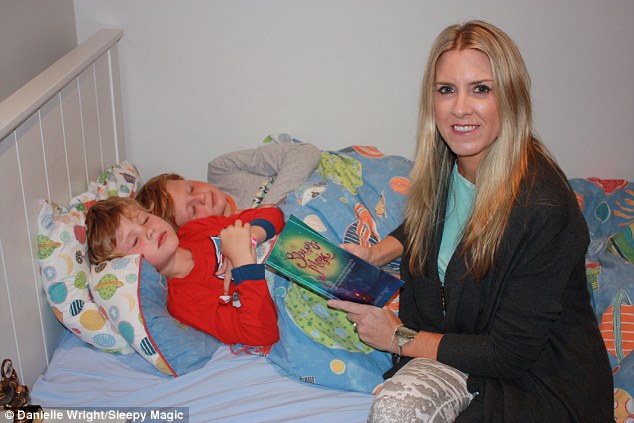
Sweet dreams: Sydney mother Danielle Wright wrote Sleepy Magic, a bedtime ritual for parents to undertake with their kids

Sweet dreams: Sydney mother Danielle Wright wrote Sleepy Magic, a bedtime ritual for parents to undertake with their kids

Tried and tested: Mrs Wright performs the five-step bedtime ritual with her sons Evan, 10 and Ben, 6, each night

Tried and tested: Mrs Wright performs the five-step bedtime ritual with her sons Evan, 10 and Ben, 6, each night

The book is a guide for parents to help combat sleepless nights.

Steps include a series of positive affirmations, asking ‘what are you proud of today?’, a breathing exercise, imaginative story and body relaxation.

Mrs Wright started the bedtime routine after a ‘mid-life crisis’ saw her leave her stressful career running an advertising agency to find peace through holistic practices.

‘I just wasn’t living the life I wanted to live,’ Mrs Wright, 43, told Daily Mail Australia.

Danielle Wright shares her secrets for getting kids to bed
Simple: The bedtime ritual includes positive affirmations, asking ‘what are you proud of today?’, a breathing exercise, imaginative story and body relaxation

Simple: The bedtime ritual includes positive affirmations, asking ‘what are you proud of today?’, a breathing exercise, imaginative story and body relaxation

HOW TO GET YOUR CHILD TO SLEEP

The Sleepy Magic book outlines five steps:

1. A series of affirmations

2. The question: ‘what are you proud of today?’

3. A breathing exercise

4. An imaginative story

5. Body relaxation

‘I was one of those supermums trying to run my own business, have a family, and run a household.

‘I thought ‘I can’t keep living like this, it’s not good for me or my family’.’

Mrs Wright visited a kinesthesiologist who taught her healing techniques, and she slowly started to shift her life.

The benefits were immense, and she started to come up with ways to incorporate the techniques in to her children’s lives.

Making a change: Mrs Wright started to develop the Sleepy Magic routine after her own 'mid-life crisis' saw her turn to a holistic way of life

Making a change: Mrs Wright started to develop the Sleepy Magic routine after her own ‘mid-life crisis’ saw her turn to a holistic way of life

‘I decided one night to do meditation on my son at bedtime,’ she said.

‘He kept asking for it … and it became a habit.

‘It made a huge difference, him getting to sleep was easy and there was no frustration around sleep anymore.’

She tried the same technique on her then three-year-old, and the results were the same.

Dream well: Steps include positive affirmations and asking 'what are you proud of today?'

Dream well: Steps include positive affirmations and asking ‘what are you proud of today?’

Shutting off: The ritual finishes by getting the child to visualise closing down their seven chakras, or energy points

Shutting off: The ritual finishes by getting the child to visualise closing down their seven chakras, or energy points

The five-step ritual includes an imaginative story or meditation and finished with the closing down of the child’s chakras or energy points.

‘I’m introducing a bit of spirituality to them,’ Mrs Wright said.

‘You are just saying to them to close down the energy inside of them, they’re doing a visualisation of shutting down.’

HEAD-HOLD AND BREATHING EXERCISE TO RELAX CHILDREN

This step is essential for calming and preparing your child for Sleepy Magic and sleep.

If they are sitting up, have them lie on their back and put one hand on the bumpy bit on the back of their head and one hand on their forehead.

Tell them to close their eyes. Say ‘breathe in’ (now count silently to four).

Then say ‘hold’ (and count silently for two).

Next say ‘breathe out’ (and count silently for four).

Repeat until you notice your child relaxing. It takes nine repetitions.

 – Sleepy Magic by Danielle Wright 

Goodnight: The book will be available in leading bookstores in Australia 

Goodnight: The book will be available in leading bookstores in Australia

Another step is having a conversation with your children about what they are proud of that day and about 90 seconds of breathing exercises.

She said the techniques were aimed at children between three and 10 years old, but they could be used on teenage children who might be feeling stressed.

Sleepy Magic is available in major bookstores.

TESTIMONIALS FROM HAPPY MOTHERS WITH SLEEPY CHILDREN

‘Danielle Wright’s book Sleepy Magic has had a profound impact on my 4 year-old son, in a relatively short period of time. After a couple of weeks of sharing some of the rituals in Sleepy Magic I have seen a dramatic increase in his emotional awareness. His feeling ‘vocabulary’ has grown exponentially and we’ve had some in-depth discussions about various emotions, following some of the affirmations and meditations.

As a children’s technology and brain researcher I understand how important sleep is for a child’s healthy development. I’ve had the privilege of seeing, first-hand with my own son, how the rituals in Danielle’s book have helped my son to not only improve his sleep habits, but they’ve also had the unexpected benefit of improving his emotional awareness. I highly recommend Danielle’s book to parents who are looking for a peaceful and practical solution to improving their children’s sleep habits.’

– Dr. Kristy Goodwin, Founder of Every Chance to Learn and mother of 2, aged 4 and 19 months

‘I took an hour off yesterday to read your book from cover to cover and the boys love it. Jamie told me this morning he slept really well, had no bad dreams and felt very calm going to sleep, his creative mind was blank and they both asked for it again tonight, such a beautiful ritual. Love it. Can’t wait for it to work on my 2 year old!’ – Minette, mother of 3 boys aged 7, 6 and 2 and owner of Swish Little Fish

‘My initial thoughts when I read through the book were literally that it was so beautiful. The look and feel of it; the illustrations; the wording – all of it is beautiful. I actually got a little emotional thinking that this would be incorporated into our nighttime routine. We have only been using it a week and my kids are already asking for it and looking forward to it every night, even though they were initially resistant. As the name suggests, it really does have a sprinkling of magic within.’

– Danielle Wicks, mother of two daughters, aged 3 and 5

‘I have just read your book given to me by my dear friend – Jess. I loved it and found it so inspirational. I have cut out the affirmations and are starting to use on one of my kids. I can’t wait to use on all 3 of my kids. I will definitely be passing the word around to my friends about Sleepy Magic!! It was great xx Thanks’

– Michelle, mother of three aged 10, 8 and 5

‘My three sons have all benefitted from Danielle’s Sleepy Magic technique. It is a calm, captivating method which helps relax and prepare children for sleep. Even active, excited children on sleep overs responded. Truly magical!’

– Heidi, mother of three boys aged 7, 9, 11

‘Although still new to Sleepy Magic, my son and I have been enjoying our bed-time ritual. This is the first time I have read to my son with his eyes closed – it is a joy to see him lie in his bed with a big grin as we run through the story together. With the help of Danielle (by email) we developed a Minecraft version of Sleepy Magic, which he absolutely loves because of course, Minecraft is big in a 7 year old’s world!’

– Erica, mother of two boys, 7 and 2

‘I have just read your book given to me by my dear friend – Jess. I loved it and found it so inspirational. I have cut out the affirmations and are starting to use on one of my kids. I can’t wait to use on all 3 of my kids. I will definitely be passing the word around to my friends about Sleepy Magic!! It was great.’

– Michelle Hutchins, mother of three aged 10, 8 and 5

‘Sleepy Magic is a twinkling little gem. It is a beautiful bonding night-time ritual for my daughters and me. The stories we make up together become more magical and more exciting every time we do it. What an incredible gift to give to every little child.’

– Mary, mother of three daughters aged 6, 7 and 9

‘I used the Sleepy Magic technique with my daughter Liv and since then she requests it every night. It has become our bedtime ritual – a beautiful 10 minutes of togetherness before she falls asleep. It calms us both down from our day. It foc

Read more: http://www.dailymail.co.uk/femail/article-3375938/Sleepy-Magic-Danielle-Wright-promises-kids-sleep-time.html#ixzz3xISvBKLi

I will admit at first, the expenses on the two neo’s (mainly the second one, the idl-80) i thought were extremelllllly high, not that they weren’t warranted, i know precious metals are high and heck, I am a business owner myself, everybody deserves to make a buck in this backwards/corrupt system!

Since I’ve received these two units, the synchronicities appearing often instantaneously just as requested from the neo are happening at an unbelievable rate. Its easy for a nonbeliever to say, “ohh, well that is just a coincidence, or there is simply no way this could work”, but as prayers (im not religious but im not sure what else to call them…maybe “requests”) have been answered these “coincidences” have been continually adding up.

For a limited time the IDL-80 is 25% off. Upgrade your meditation experience and feel the supercharged power of this meditation cube.

http://www.neologicaltech.com/product_p/idl80gk.htm

AFP

BrainCo CEO Bicheng Han wears the BrainCo Focus 1 to use bio feedback to change the color of a lamp by concentrating or relaxing during a press conference at the CES 2016 Consumer Electronics Show on January 7, 2016 in Las Vegas, Nevada
.

View gallery

  • .

Las Vegas (AFP) – The next frontier for the tech sector is the human brain.

A new breed of neuro-hacker is finding ways to capture and manipulate brainwaves to improve health, with potential to help the severely handicapped.

A number of the innovations were on display at the Consumer Electronics Show in Las Vegas, where computer scientists and biomedical experts showcased ways to tap into and use brain signals.

The “mind control” headband unveiled by startup BrainCo effectively hacks into brain signals with a range of possible applications — from helping to improve attention spans, to detecting disease, controlling smart home appliances or even a prosthetic device.

The device “translates your brainwaves into electronic signals,” said the Boston-based firm’s Zenchuan Lei.

At CES, BrainCo demonstrated how a person could use the headband to manipulate a prosthetic hand — a potential life-changer for those paralyzed or missing limbs.

“These signals can be used to control objects like a prosthetic hand,” Lei said. “You can turn the lights on or off just by focusing on that.”

The device designed by scientists from Harvard and the Massachusetts Institute of Technology employs “neuro feedback,” a means of allowing people to control their brain waves for various purposes. It is expected to be sold later this year for less than $150.

Lei suggested the device could also help people with attention deficit hyperactivity disorder because “it teaches you to enhance your focus and concentration.”

A similar project on display from New York-based OpenBCI (which stands for open-source brain-computer interface) seeks to create a platform for applications of the technology in health care, education or other fields.

OpenBCI uses a 3D-printed helmet which captures brainwaves from various sectors of the brain.

– ‘Neuro-marketing’ potential –

“This can be used to help people with ALS (amyotrophic lateral sclerosis or Lou Gehrig’s disease) or quadriplegics communicate,” said OpenBCI chief executive Conor Russomanno.

The technology also offers a potential for so-called “neuro-marketing” which tests new products and services on the basis of sensory and cognitive response.

South Korean startup Looxid Labs unveiled a headset that tracks both brainwaves and eye movements, claiming this provides more accurate insights into the mind.

“No other device that I’m aware of combines these things,” said Looxid chief business officer Alex Chang.

With the headset attached to a computer, “you can roll your eyes to scroll the mouse, and click on a button by blinking,” Chang said.

The headset is being launched in July as a developer kit, with scope to build applications for controlling physical or virtual objects, communicating, analyzing a user’s mood or mental health, or verifying their identity.

“We also see this as having potential in gaming because you can control things with your eye,” Chang said.

“When you concentrate you can stop the bullets.”

He added that for neuro-marketing applications, “we can show someone an ad and we can see where the eyes are focused. We can scan emotions and understand how someone is responding.”

Other exhibitors at CES demonstrated wearable devices that block pain signals to the brain, as an alternative to medications with side effects for people who suffer from debilitating pain.

– Meditation aid –

The neuro-feedback technique is being applied as a meditation aid by Canadian-based Interaxon and its Muse headband.

Muse uses sensors on the forehead and behind the ears to measure brain signals, and advise users how to improve their meditation technique.

The coaching app helps people achieve a level of consistency in their meditation efforts.

“It’s like going to the gym. The muscle doesn’t get stronger unless you do it over and over again. It’s the same with your brain,” said Muse marketing manager Tracy Newsom-Rosenthal at the CES show.

One startup at CES was showcasing a technique to deliver pleasure signals to the brain via music, by triggering the release of neurotransmitters such as dopamine, serotonin and oxytocin.

The hand-held device from Florida-based Nervana allows users to plug in a music player into the $299 device and get the pleasurable signals delivered by its headphones.

“We send a signal into the vagus nerve which produces dopamine, and that relaxes you,” CEO Ami Brannon told AFP on the show floor.

“Some people describe the sensation as euphoric.”

But Brannon said the technique “is not really hacking the brain.”

“We access the central nervous system and it just tickles the nerve to remind the brain to release dopamine,” she said.

“People who practice yoga or meditation can already do this.”

http://news.yahoo.com/wave-tech-hacking-brain-225739635.html;_ylt=AwrC1CmuoZhW3HYALwfQtDMD;_ylu=X3oDMTBydDI5cXVuBGNvbG8DYmYxBHBvcwM2BHZ0aWQDBHNlYwNzcg–

Relaxnews
 

The pupils who followed the mindfulness program had lower levels of somatization, depression, and negative feelings.

According to an American study published in the journal Pediatrics, mindfulness (“tuning in” instead of the “tuning out” in other meditation practices) improves the psychological health of children from low-income families.

American researchers evaluated the impact of an MBSR (Mindfulness-Based Stress Reduction) program in students from low-income, minority backgrounds, in two different public schools. The aim was to see whether these mindfulness sessions could improve the children’s psychological wellbeing and enable them to better manage their emotions.

Three hundred students in grades five through eight were followed by Erica Sibinga and her colleagues from the Johns Hopkins School of Medicine in Baltimore in the US. Of these students 99.7% were African American and 99% were eligible for free lunch. Some were allocated to the MBSR program for 8 weeks, and the others followed a health education program.

Each MBSR session included formal and informal techniques aimed at reducing dysregulated focus on the past and worries about the future.

The findings showed that the students who followed the MBSR program had lower levels of somatization, depression, negative feelings, rumination, self-hostility and post-traumatic symptoms than those who were assigned to the health education program.

In other words, mindfulness can improve psychological functioning and moderate the negative effects of stress in children. It could prove to be an effective treatment for the early management of anxious and depressive temperaments.

This work corroborates a British study published in April 2015 in the medical journal The Lancet, which showed that mindfulness-based therapies were an effective alternative to standard treatment with antidepressants for depression.

http://news.yahoo.com/mindfulness-effective-anti-stress-technique-underprivileged-children-135625188.html;_ylt=AwrC1jH3n5hW7QwAl4jQtDMD;_ylu=X3oDMTByMHZ0NG9yBGNvbG8DYmYxBHBvcwM3BHZ0aWQDBHNlYwNzcg–